Your New Favorite Hangout Doesn't Serve Lattes — It Has a Bandsaw
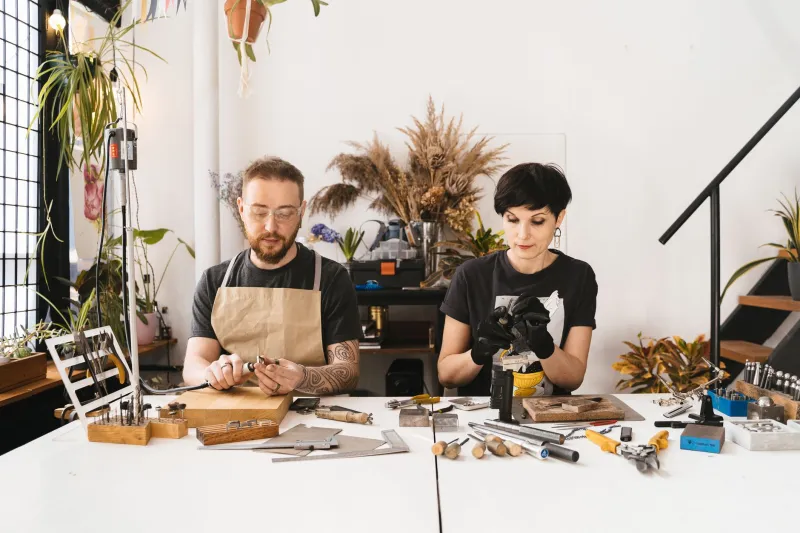
There's a woodworking shop in Austin called the Austin School of Furniture Design that has, somewhat accidentally, become one of the most socially active spots in its neighborhood. People show up to learn joinery. They stay because they keep running into the same faces, sharing the same sawdust-covered tables, and eventually, sharing the same inside jokes about their ongoing projects. A few of them have started grabbing tacos together after their Tuesday evening sessions. A couple of them are now collaborating on a side business.
None of this was the original plan. The shop exists to teach woodworking. But what it's actually doing — along with hundreds of similar spaces across the country — is filling a gap that Americans have been quietly struggling with for years.
The Third Place Problem
Urban sociologist Ray Oldenburg coined the term "third place" back in the 1980s to describe the informal gathering spots that exist outside of home (first place) and work (second place). Barbershops, diners, public parks, and yes, coffee shops — these were the places where community actually happened. Where you'd run into your neighbors, get into a debate with a stranger, or just exist alongside other humans without an agenda.
Over the last decade or two, that infrastructure has been eroding. Independent coffee shops are getting priced out. Bars feel transactional. Social media promised to replace physical community and delivered something that mostly just made people feel lonelier. And then the pandemic hit and reminded everyone, sharply, how much in-person connection actually mattered.
What's emerged on the other side is a hunger for spaces that are genuinely communal — not just places to be near other people, but places to be with them. Spaces where showing up means something.
Maker hubs and community studios are stepping into that role in a way that feels almost accidental. But it's working.
What These Spaces Actually Look Like
The category is broad, which is part of what makes it interesting. We're talking about:
- Community makerspaces and hackerspaces, like those affiliated with the national Fab Lab network, where members share access to tools like 3D printers, laser cutters, and electronics equipment
- Shared pottery and ceramics studios, which have exploded in popularity post-pandemic, often offering open studio hours alongside structured classes
- Community woodshops that let members pay a monthly fee for access to professional-grade equipment they couldn't afford to own
- Gaming lounges and tabletop game cafes, especially popular in cities with younger demographics
- Fiber arts collectives, knitting circles, and textile studios that host drop-in hours
- Community darkrooms and photography labs, which have seen a surprising resurgence alongside the film photography revival
What all of these spaces share is a structure that naturally creates repeated contact between the same people. You don't just show up once. You come back, because your project isn't done yet. And every time you come back, you see the same people — and slowly, inevitably, you start to know them.
Why Gen Z and Younger Millennials Are Driving This
It would be easy to assume that younger generations, having grown up digitally native, would be the last people seeking out physical community spaces. But the data — and the anecdotal evidence pouring out of these studios — tells a different story.
Gen Z in particular has shown a strong appetite for analog experiences. Vinyl records. Film cameras. Printed zines. Tabletop games. These aren't just aesthetic preferences — they're expressions of a deeper desire for things that feel real, tangible, and grounded in physical presence.
Shared hobby spaces deliver exactly that. They're places where your phone is usually in your pocket because your hands are covered in clay or sawdust or solder. Where the conversation is face-to-face. Where the thing you're making is real and three-dimensional and will exist in the world after you leave.
For a generation that grew up being told that online community was community, discovering that in-person connection hits differently has been something of a revelation.
Marcus, 26, started going to a community ceramics studio in Chicago after moving to the city for work and struggling to meet people. "I'd tried apps, I'd tried going to bars, I'd tried joining a rec league," he says. "Nothing really stuck. But when I started going to open studio hours, I realized I was seeing the same ten people every week. By month two, I actually knew their names. By month four, we were hanging out outside the studio. That had never happened to me before with any of the other stuff."
The Design of Belonging
There's something intentional — even if unplanned — about the way these spaces foster connection. Unlike a coffee shop, where you sit alone with your laptop and interact only if you choose to, a shared workshop puts you in proximity to other people who are doing something adjacent to what you're doing. You're sharing tools. You're asking for help. You're offering opinions on each other's work.
The activity itself creates the social permission to talk. You don't have to be extroverted. You don't have to be good at small talk. You just have to be doing the thing, and the conversation tends to happen naturally.
Many of these spaces also host events — open houses, skill-share nights, collaborative projects — that accelerate the community-building process. But even without programming, the regularity of shared space and shared activity does a lot of the heavy lifting on its own.
Finding Your Space
If you're curious about what's available in your area, a few good starting points:
- Search Meetup.com for hobby-specific groups that have a physical home base
- Look up local makerspaces through directories like makerspaces.com or the Fab Foundation's map
- Check whether your city has a tool library — many of them have evolved into genuine community hubs
- Ask at your local independent art supply or craft store — they often know about studio spaces and collectives that aren't widely advertised
Membership costs vary widely, from free community spaces funded by grants or municipalities to paid memberships that run anywhere from $30 to $150 a month. Many offer trial visits or day passes so you can get a feel for the community before committing.
More Than Just a Hobby
The thing that keeps coming up when you talk to people who've found their community through these spaces is how surprised they were. They came for the craft. They stayed for the people.
That's not a coincidence. It's what third places have always done — given people a reason to show up, and then let the human stuff happen on its own. We just forgot, for a while, that we needed them.
The maker hub and community studio movement is a reminder that belonging doesn't require a barista or an algorithm. Sometimes it just takes a shared table and something worth making.